Rachel on vintage computers
Rachel has a VIC-20 release and a playable C64 development build, both with offline solo games. More vintage versions are in development. The shared network protocol is designed for multiplayer between different machines.
There is currently no public game server. Vintage online play needs a separately run compatible server. The VIC-20 v1.0.0 release is verified in PAL and NTSC emulation, with physical hardware testing still pending. Other ports have different levels of testing, shown below.
| Machine | Networking | Evidence | Hardware | Links |
|---|---|---|---|---|
| ZX Spectrum | Next WiFi / Spectranet | Build + protocol | Real adapter path | source builds |
| Commodore 64 | Offline solo / Ultimate / user-port modem | Solo + reconnect in emulation | Physical evidence pending | source builds |
| Commodore VIC-20 | Offline solo / ESP-AT user-port modem | v1.0.0: solo + online in emulation | Physical testing pending | source builds |
| Commodore Amiga | Hayes serial modem | Build + protocol | Physical evidence pending | source builds |
| BBC Micro | User-port WiFi bridge | CI artifact | Physical evidence pending | source builds |
| Acorn Electron | WiFi expansion | CI artifact | Physical evidence pending | source builds |
| Atari 8-bit | FujiNet | CI artifact | Physical evidence pending | source builds |
| Atari 7800 | Cartridge coprocessor | Build only | Design needed | source builds |
| Oric Atmos | $031C 6551 + Hayes modem | CI TAP + RUBP v1 | Prototype needed | source builds |
| Dragon 32 / 64 / CoCo | Dragon 64 serial; other models need an adapter | Build + protocol | Physical evidence pending | source builds |
| MSX | GR8NET TCP/IP UNAPI | Emulator protocol | Real adapter path | source builds |
| ColecoVision | $50–$52 expansion FIFO | Build only | Prototype needed | source builds |
| Sega Master System | Cartridge adapter | CI artifact | Prototype needed | source builds |
| Sega Game Gear | Cartridge adapter | CI artifact | Prototype needed | source builds |
| Nintendo NES | Controller-port bridge | Emulator protocol | Prototype needed | source builds |
| Nintendo Game Boy | Buffered link bridge | CI artifact | Prototype needed | source builds |
A solo game on the VIC-20
Load Rachel with an 8KB memory expansion and choose Solo. Pick a table size from two to eight seats; computer opponents fill the other seats. The game runs locally, so solo play needs neither a modem nor a server.
Version 1.0.0 has completed solo and online games in emulation. It remains experimental on physical hardware until real-machine testing is complete. The release includes the program, controls and testing notes.
VIC-20 releases · Source and setup instructions
Playing over a network
In online mode, a server manages the cards and rules. Vintage clients show the table and send each player's moves using the shared protocol. The VIC-20's online mode has been tested against the Go server in emulation; its physical modem connection still needs testing.
There is no hosted vintage multiplayer service to join at present. The iOS app's offline solo and nearby multiplayer modes do not need one.
Pull up a chair at the C64
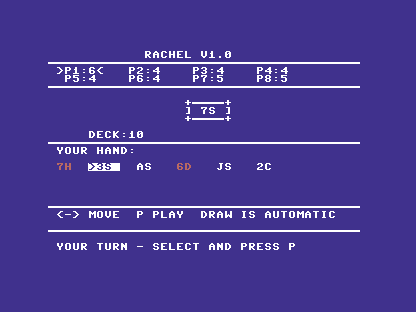
A blue screen, a handful of cards and up to seven computer opponents. The C64 development build plays a complete solo game on the machine itself. Choose Solo, pick a table size from two to eight seats, and try to leave someone else holding the cards. No modem or server needed.
Get back to the same game
Online play connects through an Ultimate interface or a user-port WiFi modem. If the connection drops, Rachel tries to recover your seat and hand. After three unsuccessful attempts, press R to retry or Q to return to the menu.
The session is kept while the program stays loaded. Resetting the C64 starts fresh. Online play needs a separately run Rachel server; there is currently no public one to join.
What has been tested
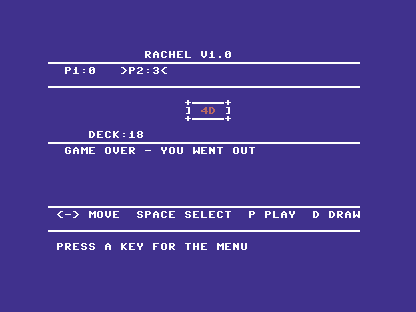
Sixteen automated solo games completed across all seven table sizes. Both emulated network transports recovered from two forced drops, restored the same seat and hand, and finished the game. Display and keyboard checks pass too.
This is a development build, verified in emulation. Physical C64, Ultimate and modem testing is still pending. The 2400-baud modem test uses 300 ms between server frames; the setup instructions explain that setting.
What the labels mean
CI artifact means GitHub assembled a downloadable test image. Build + protocol adds fixture or harness checks. Emulator boot + protocol also proves the real artifact reaches and renders its client screen. Emulator protocol executes message checks in Emu198x. Hardware labels are separate on purpose: a green software build does not prove voltage levels, timing, cabling, modem firmware, controls, or a complete game on the original machine.
Own one of these machines or adapters? Run the five-minute smoke test and report it. The form asks for reproducible, privacy-safe evidence and credits the exact hardware, firmware, client, and server revisions.
Writing one yourself
The specification is published in full, in its own repository along with the shared conformance fixtures — the message vectors a client checks itself against, so a new port can prove itself against the format before it ever reaches a real game.
Build pages linked above contain the current test artifacts where a repository uploads them. They expire with GitHub's artifact retention window. For the VIC-20, use the release downloads linked above.
If a machine you love is missing, it is missing because nobody has started it.